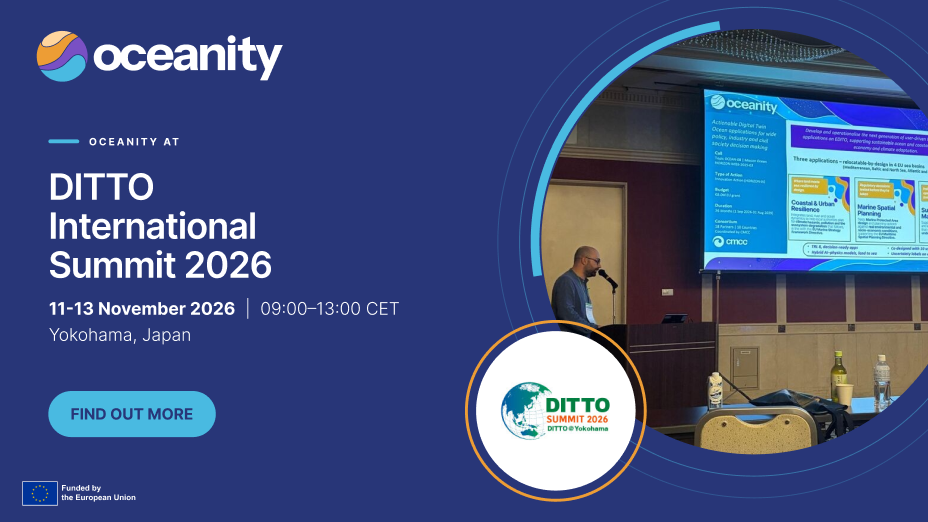
In Yokohama, Ivan Federico from OCEANITY’s coordinating organisation, the Euro-Mediterranean Center on Climate Change (CMCC), presented an interactive coastal digital twin designed for user-driven “what-if” scenarios and nature-based coastal resilience, and pointed to OCEANITY as the project through which this application will reach a more advanced level of technological maturity.
From 11 to 13 November, Yokohama hosted the DITTO International Summit 2026, the flagship global event of DITTO (Digital Twins of the Ocean), a programme of the UN Decade of Ocean Science for Sustainable Development. Following the in-person summits in London (2022) and Xiamen (2023), and an online edition in January 2026, the Summit brought together developers, scientists, operational agencies, policymakers and industry to advance the science, technology and application of ocean digital twins, with a focus on shared frameworks, interoperability, “what-if” scenario capabilities and real-world applications.
For OCEANITY, DITTO is a natural point of reference. Connecting with international programmes in the Digital Twin Ocean (DTO) landscape, DITTO among them, is part of how the project links its work on the European Digital Twin of the Ocean (EDITO) with global efforts, opening its applications to international scrutiny and uptake.
Ivan Federico presented “An Interactive Coastal Digital Twin of the Ocean for User-Driven What-If Scenarios and Nature-Based Coastal Resilience” within the session Ocean Digital Twins for Coastal Resilience, Ecosystems and Ocean Health.
Closing his talk, Ivan introduced OCEANITY as the project through which the coastal resilience application will evolve towards a more advanced level of technological maturity. Within OCEANITY, CMCC leads the development of the Coastal & Urban Resilience application, one of the project’s three DTO applications built on EDITO. The application integrates land, river and ocean dynamics to address climate hazards, pollution and ecosystem degradation, providing “what-if” scenarios for adaptation, nature-based solutions and policy testing, and supporting local authorities in planning measures such as dune construction, barrier modification, ecosystem restoration and beach nourishment.