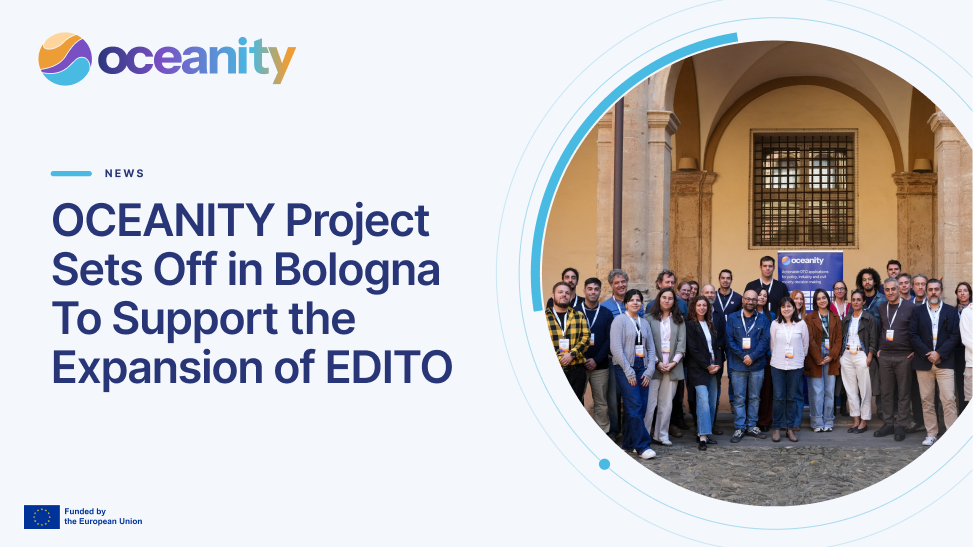
Between 13–14 October 2026, Aula Prodi of the University of Bologna welcomed the OCEANITY consortium for the project's kick-off meeting. Coordinated by the Euro-Mediterranean Center on Climate Change (CMCC), OCEANITY is a three-year Horizon Europe Innovation Action that started on 1 September 2026 and will run until August 2029.
The mission of OCEANITY is ambitious albeit clear: to support the European Digital Twin of the Ocean, turning various datasets and models into operational tools that public authorities, industry and citizens can use to make concrete decisions. Whether it is protecting a coastline, deciding whether to site an offshore wind farm next to an aquaculture site, or how to route a ship to cut emissions, OCEANITY will support a range of stakeholders by reducing risks and costs for the blue economy and ocean research.
Over two days, partners turned the project plan into a shared work programme: they agreed how users will shape the applications from the outset, how data and AI models will flow into EDITO, and which milestones the consortium must reach in its first months.
OCEANITY's predictive capabilities and climate mitigation agenda
Europe's seas face growing climate pressure, yet the knowledge needed to act is scattered across Copernicus Marine, EMODnet, EOSC and national systems. At the same time, the EU Mission Restore our Ocean and Waters, the European Green Deal, the Marine Strategy Framework Directive (MSFD) and the Maritime Spatial Planning Directive (MSPD) all call for evidence-based decision support that policy makers, businesses and citizens can actually use.
OCEANITY's answer is a next-generation, user-tailored applications supporting the use of the European Digital Twin Ocean. The project couples high-resolution, physics-based ocean models with self-learning AI emulators trained on both simulations and observations, so that forecasts and scenarios become faster and more accurate. Coupled human–nature models bring land use, socio-economic processes and coastal communities into the picture.
These capabilities will power three relocatable applications, each built on an existing technology baseline and deployed on EDITO:
Coastal & Urban Resilience (led by CMCC): floods, heatwaves and storm surges affecting coastal cities.
Marine Spatial Planning (led by Helmholtz-Zentrum Hereon): marine protected area network planning, aquaculture siting, biodiversity impact assessment, MSPD compliance monitoring and multi-use zone optimisation.
Sustainable Maritime Operations (led by the University of Bologna): emission-optimised ship weather routing and combined offshore wind and aquaculture planning.
The applications will be co-designed with users and validated through 10 use cases across all four European sea basins, including the Mediterranean, the Atlantic, the North Sea and the Black Sea, with a target of achieving the Technology Readiness Level (TRL) 8 by the end of the project. What-if scenarios and a regulatory sandbox will let decision makers test policy options before they are applied.OCEANITY is funded under Horizon Europe topic HORIZON-MISS-2025-03-OCEAN-08 (CORDIS).
Why it matters for Digital Twin technology, EDITO and the wider ecosystem
EDITO is the core public infrastructure of the European Digital Twin of the Ocean. As presented in Bologna, it was given its first public demonstration at the 2025 UN Ocean Conference and is set to be fully operational by 2030. OCEANITY arrives at the point where EDITO needs to show that its data and models can answer real-world questions at scale.
The project will contribute to this in four concrete ways:
New services on EDITO. OCEANITY will upgrade intermediate services such as SURF, VOM-LAB and AI pipelines, and add new end-user services including ship routing and offshore wind and nature-based solution planners, designed for plug-and-play deployment.
Hybrid AI–physics modelling. Self-learning AI emulators running alongside physics-based models offer a route to faster, cheaper simulations, a key step for digital twins that must deliver results on demand. The project's AI work will follow the EU AI Act.
Interoperability by design. FAIR data pipelines and compatibility with Copernicus Marine, EMODnet, EOSC, Destination Earth and EuroHPC mean that workflows built in OCEANITY can be reused elsewhere.Relocatable applications. Because each application is validated in several sea basins, other regions and users will be able to adopt it rather than build from scratch.
[Giovanni Coppini, CMCC, Project Coordinator] "Europe has invested for years in ocean observation and modelling. With OCEANITY, our goal is to turn that investment into tools that a city, a planning authority or a shipping company can use to make better decisions. Meeting in Bologna allowed us to agree, together with our users, on how we get there."
In the coming months, the consortium will launch the project website, recruit members of its User Committees and Scientific and Innovation Advisory Board, and hold an introductory webinar in December 2026.
About OCEANITY
OCEANITY (Actionable DTO applications for wide policy, industry and civil society decision making) is a Horizon Europe Innovation Action that advances the European Digital Twin of the Ocean (EDITO). It delivers three user-driven applications for Coastal & Urban Resilience, Marine Spatial Planning and Sustainable Maritime Operations, validated through 10 use cases across all four European sea basins. OCEANITY brings together 18 research organisations, universities, companies and civil society organisations from 10 countries, including the following: CMCC (Coordinator), University of Bologna, Trust-IT Services, ETT, Mercator Ocean International, Ifremer, Institut Mines-Télécom (IMT), Helmholtz-Zentrum Hereon, Deltares, TNO, Fugro, SOCIB, Lobelia Earth, National Oceanography Centre (NOC), NERSC, LNEC, Marine Cluster Bulgaria, and Seas at Risk.